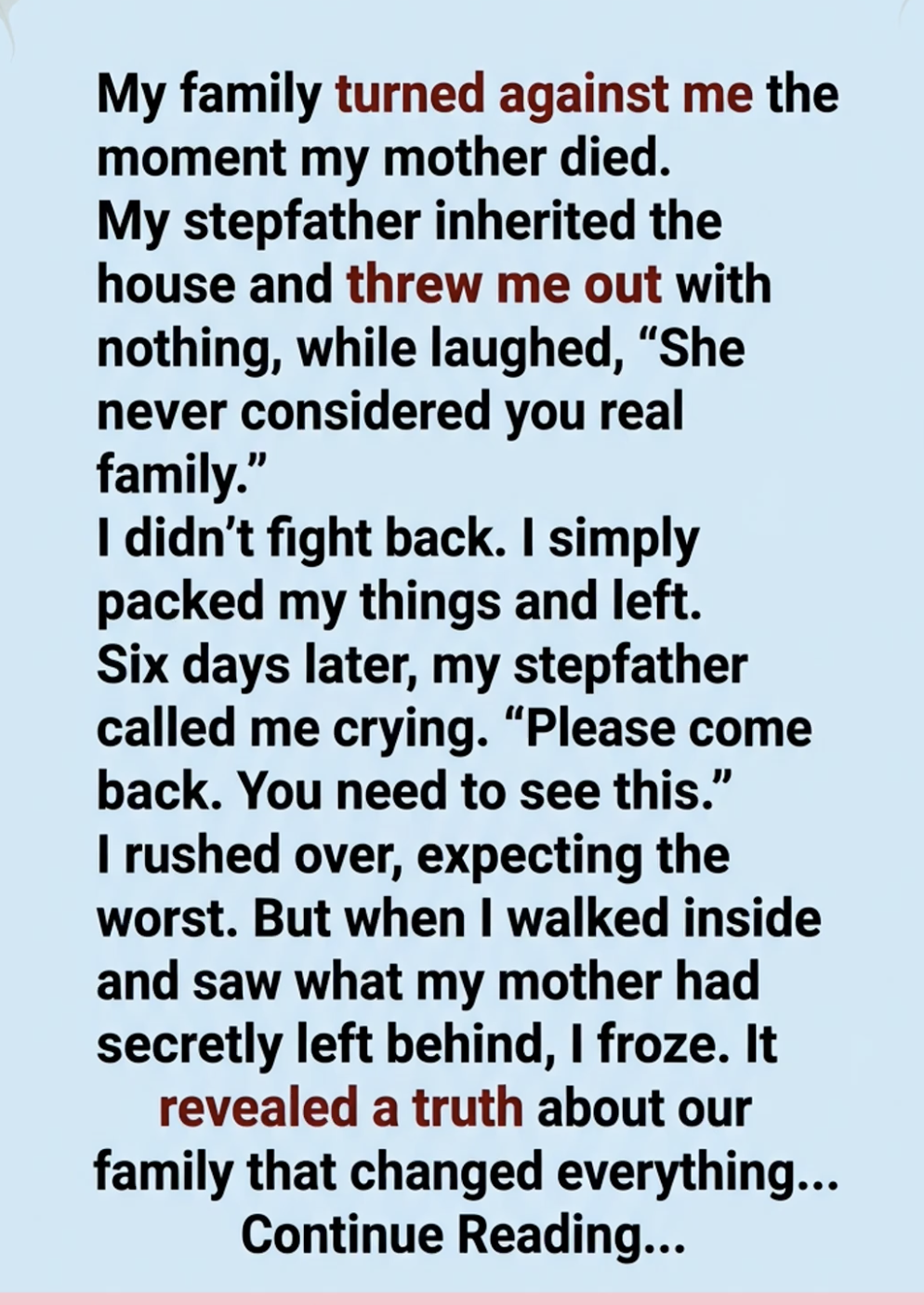
After my mother died, my stepfather inherited the house and threw me out with nothing.
I didn’t argue.
I didn’t scream.
I didn’t ask him why.
I simply packed my clothes into two suitcases, gathered the few photographs that belonged to me, and walked out the front door.
Behind me, my stepfather’s son, Brandon, laughed.
“She never considered you family,” he said.
I stopped for half a second.
Then I kept walking.
Those words hurt.
Not because I believed them.
But because a small part of me had always feared they might be true.
My mother had married Daniel when I was eleven.
He wasn’t my biological father, but for most of my teenage years, he had been the only father figure in my life.
At first, he was kind.
He taught me how to drive.
He helped me with math homework.
He showed up at my school plays.
When I got my first job, he took me out for dinner and told me he was proud of me.
Then Brandon moved in.
Brandon was Daniel’s son from his first marriage.
He was five years older than me.
And from the moment he arrived, something changed.
He treated me like an intruder.
“This is Dad’s house,” he would remind me.
“You’re just Mom’s kid.”
I tried not to let it bother me.
My mother always defended me.
Whenever Brandon said something cruel, she would tell him to stop.
“She’s your sister.”
Brandon would roll his eyes.
“She isn’t my sister.”
My mother would simply say, “She is to me.”
Those words stayed with me.
Years passed.
I eventually moved out and built a life of my own.
I married.
I had a daughter.
But I remained close to my mother.
I called her every evening.
I visited every weekend.
When she became sick, I was there.
I took her to appointments.
I prepared her meals.
I sat beside her hospital bed.
I learned how to manage the medications.
Daniel helped too.
But Brandon rarely came.
He would send flowers occasionally.
Sometimes a card.
Then, after my mother died, everything changed.
The funeral was on a Thursday.
By Friday afternoon, Daniel had called the lawyer.
By Saturday, he told me the house was his.
By Sunday, Brandon was already talking about renovating the kitchen.
I couldn’t understand how quickly everything had become about property.
On Monday, Daniel handed me a cardboard box.
“You need to take your things.”
I stared at him.
“My things?”
“Yes.”
“Where am I supposed to go?”
He didn’t answer.
Brandon did.
“You have your own family now.”
I looked at Daniel.
He wouldn’t meet my eyes.
My mother had been dead for four days.
And suddenly I was a stranger in the home where I had grown up.
I packed.
I took my clothes.
My mother’s recipe book.
A few childhood photographs.
And one small ceramic bird she had painted when I was thirteen.
Everything else stayed.
As I walked toward the door, Brandon leaned against the wall.
“She never considered you family.”
I wanted to turn around.
I wanted to ask him how he could say something so cruel while my mother’s photographs were still hanging behind him.
But I didn’t.
I left.
For six days, I didn’t hear from Daniel.
I assumed he was relieved.
I assumed Brandon had gotten exactly what he wanted.
Then, on the sixth evening, my phone rang.
It was Daniel.
His voice was shaking.
“Please come back.”
I froze.
“What?”
“Please.”
“Why?”
He began crying.
I had never heard Daniel cry before.
“There’s something you need to see.”
“What is it?”
“I can’t explain it over the phone.”
“Is something wrong?”
“Yes.”
He paused.
“Your mother left something.”
My heart started pounding.
“What?”
“I don’t know how she did this.”
“What are you talking about?”
“Just come.”
I drove to the house that night.
When I pulled into the driveway, every light inside was on.
Daniel opened the door before I could knock.
His face looked completely different.
Older.
Broken.
He stepped aside.
“Come in.”
I walked into the house.
Everything looked the same.
The hallway.
The photographs.
The old grandfather clock.
The kitchen where my mother used to make soup every Sunday.
Then I saw what Daniel was holding.
A wooden box.
It was small.
Old.
Darkened with age.
And on the top was my name.
EMILY.
I stopped breathing.
“Where did you find that?”
Daniel looked toward the staircase.
“Behind the wall in your mother’s old bedroom.”
My hands began shaking.
He placed the box on the table.
“There was a loose panel behind her dresser.”
I touched the lid.
My name had been carved into the wood.
Not printed.
Not written.
Carved.
By hand.
I opened it.
Inside were photographs.
Dozens of them.
Pictures of me as a child.
My first day of school.
My eighth birthday.
The day I learned to ride a bicycle.
My high-school graduation.
My wedding.
My daughter’s birth.
There were letters too.
Some were addressed to me.
Some were addressed to Daniel.
Some had never been mailed.
I picked up the first envelope.
My mother’s handwriting covered the front.
“For Emily, when she finally understands.”
My eyes filled with tears.
I opened it.
The first line said:
“My darling Emily, if you are reading this, then I am no longer here to explain what I should have explained years ago.”
I could barely see through my tears.
She wrote about Brandon.
She wrote about Daniel.
And she wrote about the house.
Then I reached the sentence that made my hands go numb.
“I know Daniel will inherit the house. I arranged that because I wanted him to have security after I’m gone. But that house was never the only thing I wanted you to have.”
I looked at Daniel.
He was crying.
“What does that mean?”
He didn’t answer.
I kept reading.
My mother explained that years earlier, she had purchased a separate piece of property in my name.
A small cottage on twelve acres about forty minutes outside town.
She had bought it quietly using money she had inherited from her own mother.
She had placed the property in a trust for me.
The documents were inside the box.
The cottage wasn’t enormous.
But it was completely paid off.
And it was mine.
My mother had also placed a separate investment account into the trust.
The balance was just over $186,000.
I stared at the documents.
“I don’t understand.”
Daniel wiped his face.
“She never told me.”
“You didn’t know?”
He shook his head.
“Not until today.”
Then he handed me another envelope.
“This one was for me.”
I opened it.
My mother’s handwriting was shakier.
“Daniel, I love you. But please don’t confuse inheritance with love.”
I stopped.
She continued.
“Emily is my daughter. She has spent her whole life trying to make everyone comfortable. She will probably accept less than she deserves because she doesn’t want conflict. Please don’t let that happen.”
My eyes filled again.
Then came the sentence that destroyed whatever anger I had been carrying.
“If Brandon tells her she was never family, tell him he is wrong. I chose Emily every day. Blood didn’t make her my daughter. Love did.”
Daniel covered his face.
“I was wrong,” he whispered.
I looked at him.
“You were.”
He nodded.
“I let Brandon convince me that because the house was legally mine, everything in it belonged to me.”
He looked at the box.
“I should have protected you.”
I didn’t know what to say.
Then he reached into the box and pulled out one final envelope.
It was addressed to me.
The paper was thinner than the others.
The first line read:
“You may wonder why I never told you about the cottage.”
I read on.
“Because I wanted at least one thing in your life to be yours without anyone making you feel guilty for having it.”
I started crying.
My mother knew.
She knew exactly how Brandon treated me.
She knew how often I stayed quiet to keep peace.
She knew how many times I had walked away from arguments instead of fighting.
And she had been quietly building something for me in the background.
A place where nobody could tell me I didn’t belong.
A place where nobody could say, “This isn’t your home.”
Daniel sat across from me.
“I want you to come back.”
I looked at him.
“To the house?”
He shook his head.
“No.”
He pointed toward the box.
“I want you to take everything your mother left you.”
I stared at him.
“And Brandon?”
Daniel sighed.
“He’s gone.”
“What?”
“He found out about the trust.”
I almost laughed.
“Of course.”
Daniel looked ashamed.
“He was furious.”
“What did he say?”
“That your mother had manipulated him.”
I shook my head.
“She didn’t manipulate him.”
“No.”
Daniel looked at me.
“She simply didn’t give him everything he wanted.”
The next morning, Brandon returned.
He walked into the kitchen angry.
“You knew about this?”
Daniel shook his head.
“No.”
Brandon looked at me.
“You’re really taking the property?”
I stared at him.
“It’s mine.”
“You already have a family.”
I felt something inside me harden.
“So did you.”
He looked away.
“You don’t understand.”
“No,” I said quietly.
“I understand perfectly.”
I picked up my mother’s letter.
“She didn’t leave me this because she wanted to punish you.”
Brandon crossed his arms.
“Then why?”
“Because she loved me.”
He said nothing.
Then I added,
“And she loved you too.”
His expression changed.
He wasn’t expecting that.
“She wrote about you,” I said.
“She said you were her son.”
He looked at me.
“She did?”
“Yes.”
I handed him the letter.
He read it.
For the first time in my entire life, I saw Brandon cry.
He sat down.
“I thought she loved you more.”
I shook my head.
“She loved us differently.”
He wiped his face.
“I was horrible to you.”
“Yes.”
He nodded.
“I know.”
I didn’t forgive him immediately.
Forgiveness doesn’t have to happen just because someone finally admits they were wrong.
But I didn’t hate him either.
That was enough for that day.
A few weeks later, I visited the cottage.
The key was inside the wooden box.
The house was small.
There were two bedrooms.
A little kitchen.
A porch overlooking a field.
Behind the cottage was an old apple tree.
I walked through every room slowly.
Then I found something on the kitchen counter.
Another note.
My mother had left it there years ago.
It said:
“If you’re standing here, sweetheart, then you’ve finally found a place nobody can take away from you.”
I sat on the porch and cried.
Not because I had inherited property.
Because my mother had known me well enough to understand what I needed.
She didn’t just leave me something valuable.
She left me somewhere I could never again be told I didn’t belong.
Eventually, I moved into the cottage.
I kept my mother’s wooden box on the mantel.
The ceramic bird sat beside it.
Daniel visited sometimes.
Brandon came too.
Our relationship didn’t become perfect.
It became honest.
And that was better.
Daniel eventually admitted that he had made a terrible mistake when he let grief and family pressure turn him against me.
He offered to change the house arrangement.
I refused.
“Keep it,” I told him.
“It’s yours.”
He looked surprised.
“You’re not angry?”
“I was.”
“And now?”
I looked at the wooden box.
“Now I know my mother didn’t leave me with nothing.”
I touched the carved letters on the lid.
She had left me proof.
Proof that she had seen me.
Proof that she had remembered every sacrifice.
Proof that being pushed out of a house didn’t mean I had been pushed out of her heart.
Years later, I still think about the night Brandon told me:
“She never considered you family.”
He had been wrong.
Completely wrong.
My mother had spent years preparing an answer to that sentence.
She had hidden it behind a wall.
Inside a wooden box.
Under photographs and letters.
And when I finally found it, I understood something I wish I had known sooner.
Sometimes family isn’t proven by who gets the biggest room.
It isn’t proven by whose name is on a deed.
It isn’t even proven by who shares your blood.
Family is proven by who remembers you when you’re not in the room.
Who protects you when you aren’t there to defend yourself.
Who quietly prepares a place for you in a future they know they won’t live to see.
My mother couldn’t stop my stepfather from making the mistake he made.
She couldn’t stop Brandon from saying cruel things.
But she had made sure that neither of them could ever erase my place in her life.
And when I stood on the porch of the little cottage she had secretly left me, I finally understood her last message.
She hadn’t forgotten me.
She had been thinking of me all along.
And that was worth more than the house.
More than the money.
More than anything my brothers, stepfather, or anyone else could ever leave behind.
Because my mother didn’t just leave me an inheritance.
She left me something no one could take away.
The certainty that I had always been loved.