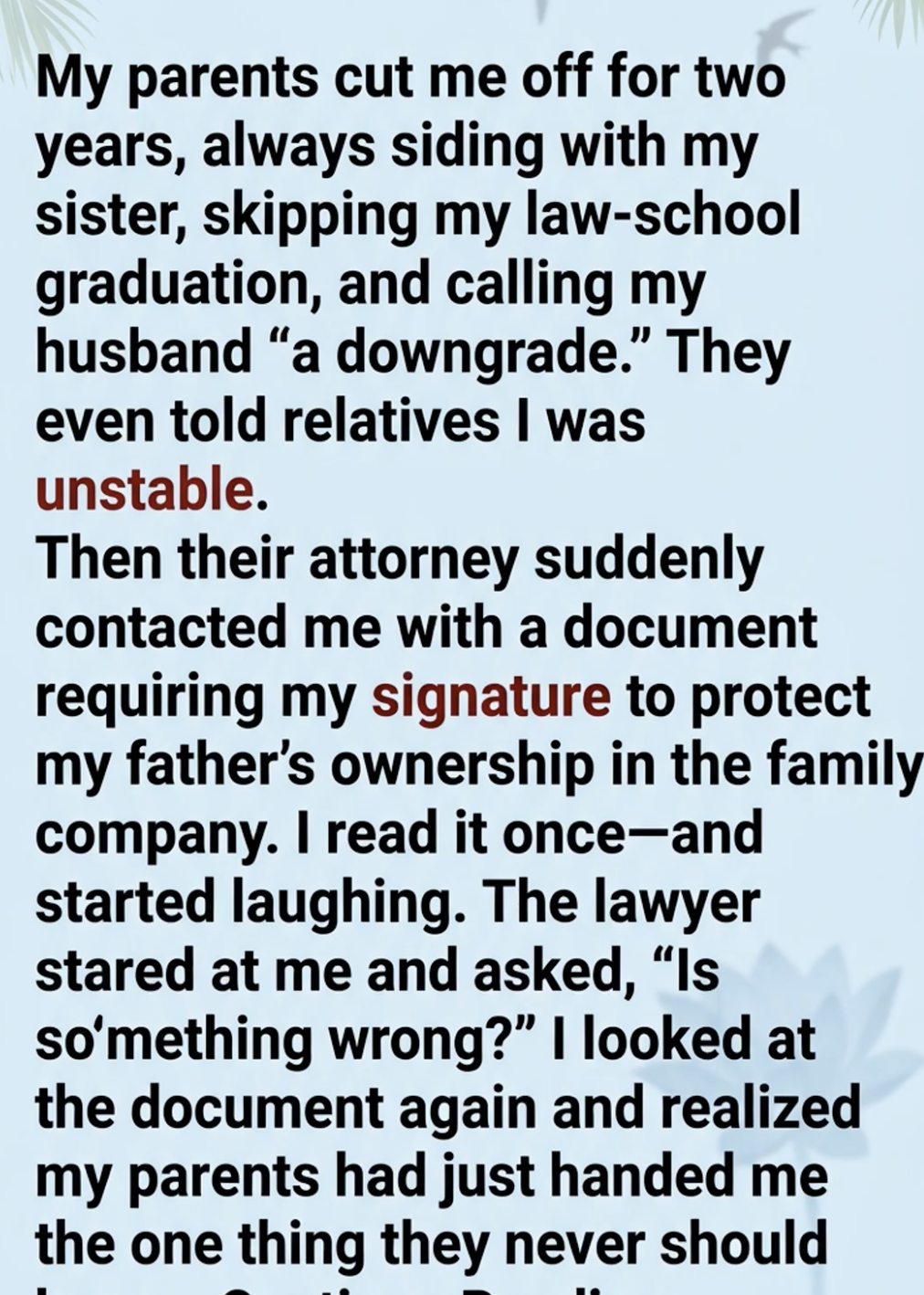
My parents didn’t speak to me for two years.
Not because I had done something terrible.
Not because I had betrayed them.
They simply decided my sister deserved their loyalty more than I did.
It started after I married Daniel.
My parents never liked him.
“He’s a downgrade,” my father said the first time they met.
My mother didn’t correct him.
Instead, she looked at me and asked:
“Are you sure you know what you’re doing?”
I did.
Daniel wasn’t wealthy.
He didn’t come from a prominent family.
He didn’t drive an expensive car.
But he respected me.
He supported my career.
And he never made me feel like I had to earn his love.
My parents couldn’t understand that.
My sister, Rachel, could do no wrong.
When Rachel needed money, they gave it.
When she made a mistake, they defended her.
When I objected, they called me jealous.
Then I graduated from law school.
It should have been one of the happiest days of my life.
My husband was there.
My friends were there.
My professors were there.
My parents weren’t.
They said they were “busy.”
Later, I learned they had attended Rachel’s weekend getaway instead.
When relatives asked why my parents weren’t at my graduation, my mother told them I had become “unstable.”
That word spread quickly.
An aunt called me.
“Are you doing okay?”
“Yes.”
“Your mother is worried about you.”
“Why?”
“She says you’ve been acting strangely.”
I knew exactly what was happening.
They were rewriting the story.
Instead of admitting they had chosen not to come, they told everyone I was the problem.
Eventually, I stopped defending myself.
I focused on my career.
Daniel and I built our life.
Two years passed.
Then, on an ordinary Tuesday morning, I received an email from an attorney.
The subject line read:
Family Company — Signature Required
I almost deleted it.
Then I saw the attorney’s name.
Thomas Reed.
He represented my father.
I opened the email.
“Your father has requested that you execute the attached document concerning ownership and governance of the family company.”
I stared at the screen.
The family company.
My grandfather had started it.
My father had taken over decades later.
My sister worked there.
I had worked there briefly after college before leaving to attend law school.
I had never been involved in its ownership.
At least, that’s what I’d been told.
I downloaded the document.
There were pages of legal language.
Share ownership.
Voting rights.
Transfer restrictions.
Successor interests.
I read it once.
Then again.
Then I started laughing.
Not because it was funny.
Because I couldn’t believe what I was seeing.
The lawyer called almost immediately.
“Is something wrong?”
I said:
“Mr. Reed, did my father tell you I was unaware of the company’s ownership structure?”
He paused.
“No.”
“Did he tell you I’ve never seen these records?”
Another pause.
“No.”
I looked at the document again.
“Then I think you should read your own attachment.”
“What do you mean?”
“Page seventeen.”
I heard papers moving.
Then silence.
“What are you seeing?”
I said:
“My name.”
He didn’t answer.
“It’s right there,” I continued. “I’m listed as a shareholder.”
His voice became cautious.
“Yes.”
“How many shares?”
Another pause.
“Thirty percent.”
I laughed again.
“Thirty percent?”
“Yes.”
“And my sister?”
“Ten percent.”
I leaned back in my chair.
My parents had spent two years telling relatives I was unstable.
They had cut me off.
They had skipped my graduation.
They had insulted my husband.
They had sided with my sister.
And all along, apparently, I owned thirty percent of the company.
I asked:
“Why does this document require my signature?”
“Because your father is attempting to restructure the ownership.”
“Restructure how?”
“He wants to transfer certain voting rights.”
“To whom?”
The lawyer hesitated.
“Your sister.”
Of course.
Rachel was supposed to receive control.
My father wanted me to sign away rights I hadn’t even known I possessed.
I said:
“I’m not signing anything.”
“That is your decision.”
“I’ll have my own attorney review it.”
“I strongly recommend that.”
The call ended.
Daniel was sitting across from me.
“What happened?”
I handed him the document.
He read it.
Then looked at me.
“You own thirty percent?”
“Apparently.”
He smiled.
“You should probably tell your parents.”
“I think they’ll find out.”
I called my father.
He answered on the third ring.
“Hello?”
“Dad.”
Silence.
“What do you want?”
“I received a document from your attorney.”
“I assume you’re referring to the company.”
“Yes.”
“Good. Sign it and send it back.”
I laughed.
“That’s your entire explanation?”
“What explanation do you need?”
“I’d like to know why you want me to sign away thirty percent of a company I didn’t know I owned.”
Silence.
Then:
“Who told you that?”
“Your attorney.”
He became angry.
“That document wasn’t supposed to—”
He stopped.
I waited.
“Wasn’t supposed to what?”
He didn’t answer.
I said:
“You’ve spent two years telling everyone I was unstable.”
“Don’t start.”
“You told relatives I couldn’t be trusted.”
“You were behaving irrationally.”
“I graduated law school.”
“That doesn’t make you right.”
“No.”
I looked at the document.
“But this does.”
He was silent.
I continued.
“Why didn’t you ever tell me I owned thirty percent?”
“Because you weren’t involved in the company.”
“That doesn’t change ownership.”
“You left.”
“I went to law school.”
“You chose your husband.”
“You’re proving my point.”
He hung up.
My mother called twenty minutes later.
“You’re making a terrible mistake.”
“I haven’t made any decision.”
“You’re going to destroy the company.”
“No.”
“Your sister has built her career there.”
“So have you and Dad.”
“Rachel deserves control.”
“Why?”
“She stayed.”
I almost laughed.
“So did I.”
“You left.”
“For law school.”
“You chose Daniel.”
“Yes.”
“Over your family.”
“No.”
I looked at the document.
“You chose Rachel over me.”
Silence.
Then she said:
“You don’t understand what your grandfather wanted.”
I froze.
“What did Grandpa want?”
“He wanted the family to stay together.”
“Then why was I given thirty percent?”
She didn’t answer.
I knew there was more.
I hired my own attorney.
Her name was Julia.
She reviewed the company documents.
Then she asked me:
“Did you know your grandfather left you these shares?”
“No.”
“Did you ever sign a transfer?”
“No.”
“Did you receive dividends?”
“I don’t think so.”
She looked through the records.
“You didn’t.”
“Where did the money go?”
Julia kept reading.
“Your shares appear to have been held in trust for you until you completed law school.”
I stared at her.
“Why?”
“Because your grandfather anticipated that your father might try to pressure you.”
I felt my heart pound.
“My grandfather knew?”
“Apparently.”
Julia handed me another document.
It was a letter.
Written in my grandfather’s handwriting.
Dated eleven years earlier.
I read it.
It said:
“If you’re reading this, my granddaughter has reached adulthood and completed her education. I want her to know that I left her thirty percent of the company because she has always asked the difficult questions.”
I swallowed.
Then continued.
“Her father may believe the company belongs to him because he runs it. But ownership and management are different things.”
My hands began shaking.
There was more.
“I have watched my children argue over who deserves more. I don’t want my granddaughter dragged into that fight. Give her the shares quietly. Let her decide whether she wants involvement.”
At the bottom was a sentence that made me cry.
“Never allow family pressure to make you surrender something simply because someone tells you it would keep the peace.”
I put the letter down.
My grandfather had known.
He had planned for this.
And my parents had apparently hoped I would never discover it.
Julia continued researching.
She found something even more troubling.
For years, my father had been using the company’s voting structure as though he had complete control.
My thirty percent had remained dormant because I hadn’t exercised the rights attached to it.
Now he wanted my signature because he needed my consent for a restructuring that would effectively increase Rachel’s control.
Without my signature, the transaction couldn’t proceed as planned.
That explained everything.
The sudden email.
The urgency.
The insistence that I sign.
They weren’t doing me a favor.
They needed me.
The same parents who had spent two years pretending I didn’t matter suddenly needed my signature to protect the future they had planned for my sister.
I didn’t sign.
Instead, my attorney requested the complete corporate records.
My parents resisted.
That only made things worse.
The records showed that my grandfather’s trust had transferred the shares to me properly.
My ownership was legitimate.
My parents knew.
My sister knew.
The attorney’s office knew.
Everyone knew except me.
Rachel called me one evening.
“I didn’t know.”
I believed her.
“Did Mom and Dad tell you I owned thirty percent?”
“No.”
“Did they tell you they wanted me to sign it over?”
She was quiet.
“Yes.”
“Did they tell you why?”
“They said it was for the good of the company.”
I sighed.
“Do you want control?”
“I wanted what they told me was mine.”
That sentence changed something between us.
For years, I had thought Rachel was part of the problem.
Maybe she was.
But perhaps she had also been raised inside the same story.
She asked:
“Are you going to take the company?”
“No.”
“Then what are you going to do?”
“Make sure nobody takes what belongs to me.”
Eventually, we reached a settlement.
I retained my thirty percent ownership.
My father remained involved in management for a limited transition period.
Rachel received additional operational authority but not ownership she hadn’t legally earned.
And the company adopted a formal governance structure.
No more secret transfers.
No more family promises.
No more decisions made around a dinner table.
Everything had to be documented.
My father didn’t apologize immediately.
It took months.
One afternoon, he came to my office.
He sat down.
“I was wrong.”
I looked at him.
“About what?”
“About you.”
I waited.
“I thought because you left the company, you didn’t care about it.”
“I cared about my career.”
“I know.”
“And I cared about you.”
He looked down.
“I shouldn’t have called you unstable.”
“No.”
“I shouldn’t have skipped your graduation.”
“No.”
“I shouldn’t have treated Daniel like he was beneath you.”
“No.”
He sighed.
“I’m sorry.”
I believed that he was sorry.
But forgiveness didn’t mean pretending nothing happened.
“I can forgive you,” I said.
“But things won’t go back to how they were.”
He nodded.
“I understand.”
My mother took longer.
Eventually, she apologized too.
Not perfectly.
Not elegantly.
But honestly.
“I thought protecting Rachel meant choosing her,” she said.
I looked at her.
“You didn’t have to choose.”
She started crying.
“I know.”
I hugged her.
But I kept my boundaries.
I didn’t move back into the family company.
I didn’t give up my career.
And I didn’t sign away the thirty percent my grandfather had intentionally left me.
I eventually became a legal adviser to the company—not because my father asked me to, but because I wanted to help modernize its contracts and governance.
Rachel continued managing operations.
Our relationship became complicated but functional.
And my parents slowly learned that their daughters didn’t have to compete.
Years later, I still keep my grandfather’s letter in my desk.
Sometimes I read the final line.
“Never surrender something simply because someone tells you it would keep the peace.”
For two years, my parents had treated me like I was disposable.
They told relatives I was unstable.
They called my husband a downgrade.
They skipped the day I earned my law degree.
Then their own attorney sent me a document they expected me to sign without reading.
They thought it was a formality.
Instead, it revealed the truth.
They hadn’t forgotten me.
They had been trying to get something from me.
And the one thing they handed me that day wasn’t a contract I needed to sign.
It was proof.
Proof that my grandfather had believed in me.
Proof that my parents had known exactly what I owned.
And proof that I never needed their permission to stand up for myself.
The document they sent to silence me became the document that finally gave me a voice.